1. As a consequence of how diversity citizenship is used nowadays, federal courts now serve primarily corporate interests.
In law school, students are taught that diversity jurisdiction was necessary to ensure fairness when adjudicating disputes between individuals from different states.
Nowadays, however, the reality is that most individuals live, die, and engage in commerce and disputes in just one state. The idea that an individual in New Hampshire has a dispute with an individual in Virginia, is pure fiction. The vast majority of individuals will never see the inside of a federal court. Most individuals are involved with legal issues at the state level, only, in custody disputes, parking tickets, divorces, or automobile accident cases.
On the other hand, corporations routinely transact business and operate in more than one state, because it is profitable for them to do so.
As a result, federal courts have become ubiquitous for corporations and now serve largely corporate interests, in part, simply because corporations are most likely to appear more repeatedly and consistently in federal court under diversity jurisdiction.
In fact, based on recent date from the federal courts, 47% of cases in federal court were based on diversity jurisdiction. Although this data does not specify who is invoking diversity jurisdiction — individuals or corporate entities — the reality addressed above of corporations operating in more that one state and individuals not, is an unavoidable and persistent reality. (https://www.uscourts.gov/data-news/reports/statistical-reports/judicial-business-united-states-courts/judicial-business-2023)
2. The Civil Justice Reform Act (CJRA) fundamentally altered procedural fairness for plaintiffs in federal courts.
A fundamental change in federal court procedure occurred in 1990 with the passage of the Civil Justice Reform Act (CJRA). Today the cumulative and on-going effects of the CJRA are rarely discussed and its effects are poorly understood.
The CJRA required each district court to implement a “Civil Justice Expense and Delay Reduction Plan.” This plan, among other things, sets hard limitations on the amount of time parties have to perform discovery and prepare their cases for trial. The realities of litigation means that these time limitations affect individual plaintiffs more profoundly, for several reasons.
Many federal courts have enacted “fast track” systems, which unnecessarily and unreasonably speed up the pace of litigation, to the detriment of individual plaintiffs
First, individual plaintiffs, even if represented by competent counsel, do not have the same legal resources and funding as large corporations. Large corporations are almost always represented by large law firms, sometimes international law firms, that have more resources that individual attorneys. On the other hand, individual plaintiffs and their attorneys have less resources and usually less funds available to litigate a case.
Secondly, time limitations tend to operate more to the detriment of individual plaintiffs than corporate defendants, for several reasons. Most importantly, plaintiffs typically need more time fore discovery sinply because the plaintiff has the burden of proof and, at least some of the necessary records are usually in the possession of the defendant. Furthermore, given this dynamic, the defendant corporation has the incentive not to provide the records, which is always the case, but this dynamic becomes worse in federal court, because of time restrictions and limitations to limit time to bring motions to compel discovery.
On the other hand, most state courts implement procedural systems that ensure more time for plaintiffs to litigate cases, including a more-practical case-by-case approach to discovery and trial calendaring.
3. Many federal courts have enacted discovery provisions that limit and impede discovery rights, to the detriment of individual plaintiffs
Many federal courts have enacted standing orders, or administrative orders, that frustrate, limit, and impede discovery rights.
For example, in the United States District Court, District of New Mexico,
4. Many federal judges are older conservative men, because they are appointed for life.
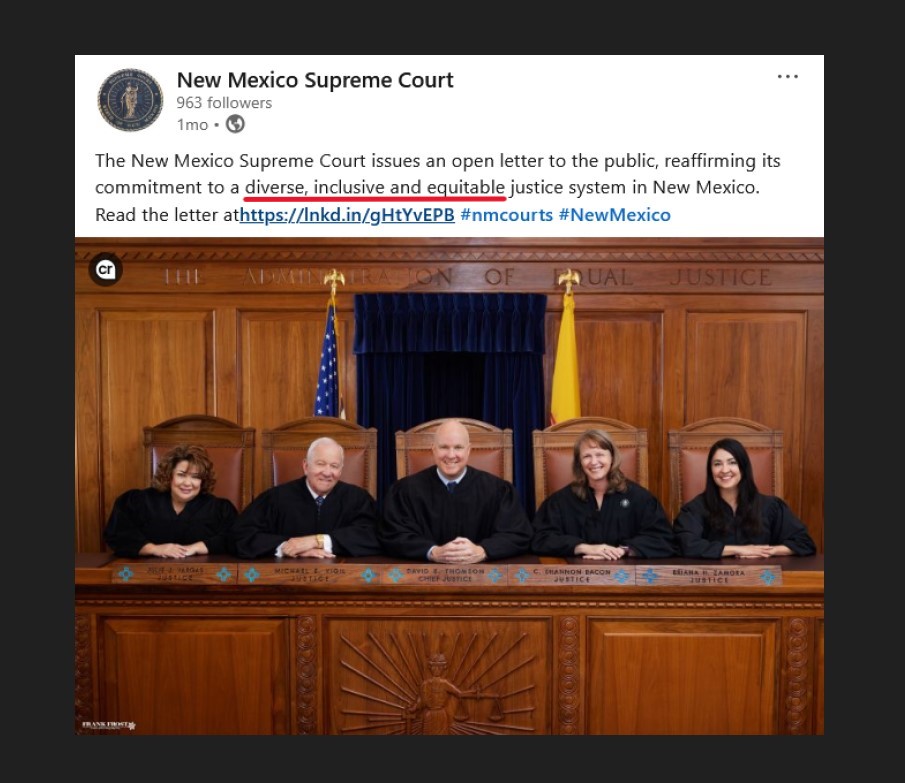
Unlike in state court, many federal judges, known as “Article III judges” are appointed for life. As a result, many federal courts are packed full of older judges, and mostly men. As a matter of statistical fact, older individuals tend to be more conservative. (https://www.pewresearch.org/short-reads/2014/07/09/the-politics-of-american-generations-how-age-affects-attitudes-and-voting-behavior/)
As a result, the tendancy for life appointed federal judges makes the federal courts a conservative forum. Conservative forums are necessarily anti-plaintiff, because anytime a plaintiff seeks redress in the court system, they are necessarily contesting the status quo.